Thursday, 9 October 2014

Post 7: Introducing Tallat Naqvi

Introducing…

Tallat Naqvi – Officer – Publications Standards – CCMC

 Tell us a bit about yourself.

My name is Tallat Naqvi and I am originally from Pakistan. I enjoy cooking, jogging, reading and watching Indian/Pakistani dramas during my free time. I have been working here since 1998 and my responsibilities include preparing drafts/final drafts/publications for parallel ISO projects in line with the Vienna Agreement, handling IEC weekly notifications to CCMC for launching parallel CDV and FDIS procedures in line with the Dresden agreement, handling late translations for CEN and CENELEC, etc. 

What are you working on right now?

I am encoding IEC voting start and end dates, titles in English and French and CDV/FDIS references in our database; then launching and saving the notifications ready for the upload to CENELEC Members on Friday.

What is involved in handling ISO and IEC notifications?

Well, firstly the full text editing is all managed by the ISO/CS and IEC/CO editors in Geneva.  Here in Brussels we issue a dispatch notice for each parallel project.  This dispatch notice consists of a single page where we mention key information like work item number, reference, start and end vote dates, titles, etc.  It's not as time consuming as editing but we have to really verify that the information we provide to our members is correct and not in contradiction with the ISO and IEC data.  Once the ballot start dates are reached, we ensure that an electronic ballot is opened so that our Members can submit their votes and comments.

Did you know?
There are two Agreements established for the cooperation of CEN and ISO work and CENELEC and IEC work.  The Vienna Agreement covers CEN and ISO collaboration and so far this year 31% of CEN's total portfolio of published work is identical or based on ISO work:


The Dresden Agreement covers IEC and CENELEC work and so far this year 78% of CENELEC's total portfolio of published work is identical or based on IEC work:
 
If you have any questions about above, feel free to post a comment or to send me a message!

Tallat Naqvi (tnaqvi@cencenelec.eu, production@cencenelec.eu)


© All CCMC posted information is copyrighted by CEN and/or CENELEC.  Extracts may be used providing that the source is mentioned.
Please note that the CCMC posted information is drawn from a variety of sources already publicly available on the CEN and CENELEC websites.


Monday, 6 October 2014

Post 6: Terms and definitions


This week we are turning our attention to terms and definitions and looking at the fundamentals of drafting and presentation.
See Annex D in the Internal Regulations Part 3 for additional guidance on the drafting and presentation of terms and definitions.


Terms and definitions are to be listed in Clause 3 of CEN and CENELEC deliverables and are a normative optional element.

Any term or symbol which is not self-explanatory or commonly used and which can be interpreted differently in different contents shall be defined in Clause 3. 
The form of a definition shall be such that it can replace the term whenever it is used in the document. Any additional information shall be given only in an example or note to entry.

Note 1 to entry:           Notes to entry differ from notes integrated in the text. They may provide provisions, further technical details and are always numbered.
You will notice that the grammar used in terms and definitions is quite distinct. Terms shall be presented in their basic grammatical form, i.e. nouns in the singular, verbs in the infinitive.

Before a term or definition can be established for a concept it should be ensured that no other term and definition for that concept exist in order to avoid duplications and contradictions. This can be easily checked via the terms and definitions search function on the ISO Online Browsing Platform www.iso.org/obp/ui/ or on Electropedia, the IEC Online Electrotechnical Vocabulary database. Where it is necessary to repeat or modify an existing definition, the source information shall be given in square brackets, after any note to entry, with an indication of the modification.
Finally, terms and definitions should preferably be organized according to the hierarchy or grouping of concepts. If this is not possible then alphabetical order is also permitted.


The best way to capture this is visually. Here is an example, outlining the correct layout and presentation of terms and definitions:


It is important that the term number, the term, the abbreviated term (if any) and the definition are each formatted as separate paragraphs, with no line breaks. If you look to the highlighted text in the example you will note that both terms and definitions start by using lower case letters and that definitions do not require a full stop to conclude.

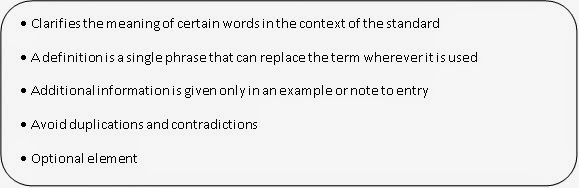
Now, let's finish with a summary of the key aspects to keep in mind when drafting terms and definitions:

Any questions about the topics covered in this post? Post us a comment!
 
And don’t forget to follow us – next week we will be blogging about notes and examples…

 
Sarah Gibson (sgibson@cencenelec.eu, production@cencenelec.eu)


© All CCMC posted information is copyrighted by CEN and/or CENELEC.  Extracts may be used providing that the source is mentioned.
Please note that the CCMC posted information is drawn from a variety of sources already publicly available on the CEN and CENELEC websites.


Thursday, 2 October 2014

Post 5: Introducing Elysia Booth


Introducing…
Elysia Booth – Administrator – Publications Standards – CCMC

 Tell us a bit about yourself.
My name is Elysia Booth and I am originally from New York, but my love for travel has landed me here in Belgium! I spend a lot of my free time reading, writing and skyping with family and friends abroad, but I also love music and enjoy going to local concerts and festivals.  I have been working at CCMC for two years and my primary responsibilities are editing and quality checking final drafts and publications of European deliverables.

What are you working on right now?
I am quality checking a final draft of a European Standard, which has been edited by my colleague, before I send the document out for translation.

What is involved in the quality checking process?
Well, once a deliverable has been fully edited by a member of the Publications Unit, it will be given to another editor on the team to perform a quality check before the document is sent for translation. On Thursdays, our team of editors will quality check any documents allocated to us, by carefully proofreading each text, checking that the implementation dates are correct and making sure it has a good overall layout. After we’ve quality checked a document, we will update the database to ensure the tracking of the QC step, transparency to external contacts regarding the process of the project within CCMC and proper reporting for our Timeframe Processing KPI. Once we’ve done the encoding in the database, we will dispatch the edited and quality checked deliverable to the translators.

If you have any questions about above, feel free to send me a message!

Elysia Booth (ebooth@cencenelec.eu)


© All CCMC posted information is copyrighted by CEN and/or CENELEC.  Extracts may be used providing that the source is mentioned.
Please note that the CCMC posted information is drawn from a variety of sources already publicly available on the CEN and CENELEC websites.

Monday, 29 September 2014

Post 4: Normative References


Now let us turn our attention to normative references and the most frequently asked questions and commonly experienced problems. 

First, let's start with the basics:

What is a normative reference?
 
A normative reference is a document to which reference is made in such a way as to make it indispensable for the application of the standard. This therefore assumes that obtaining any document which is normatively referenced is essential for the proper implementation of the standard.

Normative references have to be referred to normatively in the body of the document at least once. See Table H.1 in the Internal Regulations Part 3 for precise guidance on how to express requirements.

To differentiate, an informative reference is either a document which is directly referenced in the standard, but the use of which is not indispensable for the application of the standard, or a document that the drafting body used as an informal source for the drafting of the text. Informative references should be listed in the bibliography.

The key question to ask when tackling normative references is whether the document you are referencing is in fact indispensable to the application of the standard and is it directly referenced at least once in the body of the text? Is it normative or informative?
How and where should I list normative references?
 
Normative references are listed in Clause 2 of CEN and CENELEC deliverables, however they are an optional element and are not essential.

Here is an example of how a normative reference should appear in Clause 2: 

EN 50539-11, Low-voltage surge protective devices – Surge protective devices for specific application including d.c. – Part 11: Requirements and tests for SPDs in photovoltaic applications

When does a normative reference have to be dated?
 
References need only to be dated when they are being used to refer to a specific element (e.g. clause, subclause, annex, numbered list entry), formula, table or figure in the referenced document. This is because a new edition of a standard may not have the exact same order of content as its previous version.

Where both normative and informative references are undated then the latest version of the referenced document, including any amendments applies.

It is essential that the normative references are as up-to-date as possible and that the latest version is used so that the published text remains state of the art. It is also essential that any document which is normatively referenced is publicly available and not at draft stage. 

In certain special cases, references may have to be dated, even though no specific element from it is mentioned. For example, in some cases deliverables are required to meet the Essential Requirements of New Approach Directives, in which case normative references which appear in a clause which is listed in the Annex ZA may need to be dated in Clause 2. 

This occasionally calls for a case-by-case approach during editing and a close collaboration between the editor, the drafting body and other stakeholders – e.g. Consultants.

If you have any queries about the document you are working on then feel free to drop us a line at production@cencenelec.eu. 

Where can I find the information regarding the most recent version of an EN and its title?
 
You can find all the necessary information on Projex-Online. Other helpful sources of information are the Search areas on the CEN website (http://standards.cen.eu/dyn/www/f?p=CENWEB:105::RESET::::) and on the CENELEC website (http://www.cenelec.eu/dyn/www/f?p=104:107:2583858426572501::::FSP_LANG_ID:25).

What if I have a normative reference which is not a CEN, CENELEC, ETSI, ISO or IEC standard?
 
Are you drafting a CENELEC EN?  There is a CENELEC Guide 10 that has been adopted by the Technical Board and gives the relevant information: http://www.cenelec.eu/membersandexperts/referencematerial/cenelecguides.html.

Are you drafting a CEN EN? The responsible Technical Committee has to take a formal TC Decision.  The formatted decision can be found in Section 2.2 on the following page of the CEN BOSS website: http://boss.cen.eu/reference%20material/FormattedDecisions/Pages/default.aspx and must be returned to CCMC at: tcminares@cencenelec.eu.

Summary 

To recap here is a handy summary that includes some of the key points to keep in mind when considering normative references:

o   Optional element
o   List documents which are indispensable for the application of the standard

o   Date references if they refer to a specific element in another document, e.g. table, figure…

o   Refer preferably to other European Standards

o   Standards from other organizations can be referenced under certain conditions

o   Normative references must be referred to normatively in the body of the text at least once in order to appear in Clause 2

o   Avoid references to:

o   drafts (unpublished work)

o   documents that are not publicly available

o   documents that are referred to informatively

o   documents that have served as background material in the preparation of the document

Normative references can be a difficult aspect of drafting standards and the Editors at CCMC are always here to provide you with support on any queries you might have throughout the drafting process. 

Any questions about the topics covered in this post? Post us a comment!

And don’t forget to follow us – next week we will be blogging about terms and definitions…


© All CCMC posted information is copyrighted by CEN and/or CENELEC.  Extracts may be used providing that the source is mentioned.
Please note that the CCMC posted information is drawn from a variety of sources already publicly available on the CEN and CENELEC websites.